
Too Embarrassed to Escalate
14 October 2026
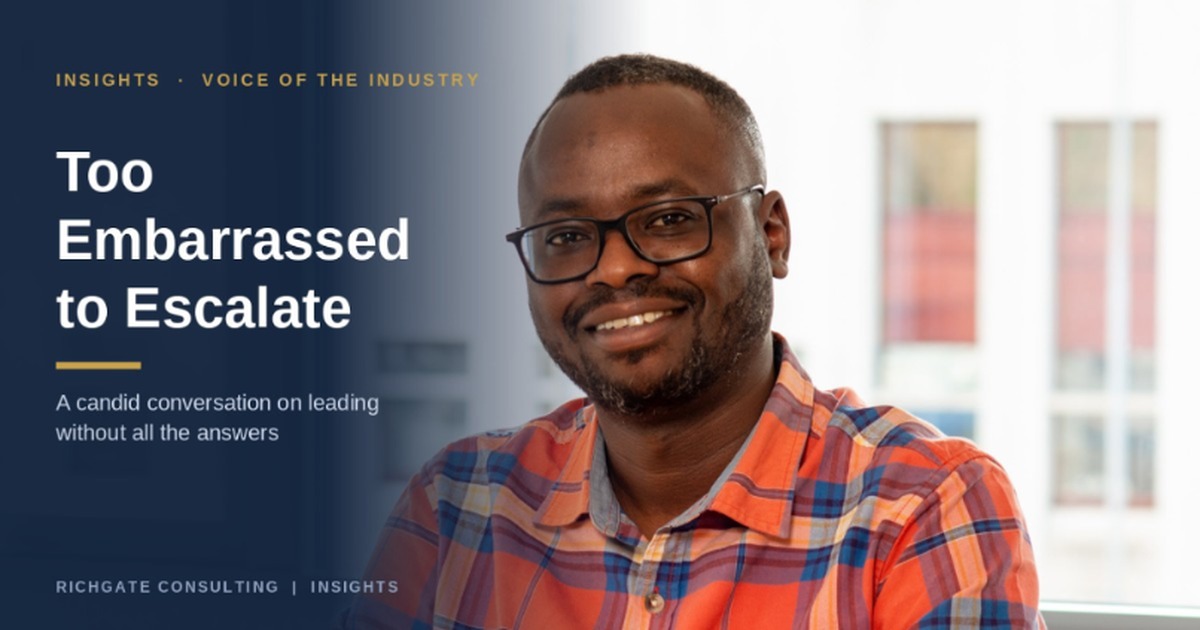
The main liquid supply to the packaging plant failed on a night shift. A fix that would have taken five minutes was sitting there, waiting for someone to ask for help. Nobody did. By the time the day shift arrived, the plant had lost a significant volume of output, and the reason was not technical. The person running that shift was too embarrassed to escalate.
Many operations leaders will recognise a version of that story. The machine is rarely the whole problem. The problem is the silence around it: the fear of looking inexperienced, the handover nobody owns, the escalation path that exists on paper and not in practice. Inside a plant, everyone is busy and everyone is watching their own step, which is exactly why problems travel so far before anyone names them.
That is where an outside voice earns its place. Not to replace the people who know the plant best, but to be the one person in the room with no step of their own to protect. A good consultancy asks the question that is awkward to ask from the inside, puts the whole chain on one page, and says the difficult thing early, before the cost shows up in output, in margin or in a customer lost. In East Africa, where ports, currencies and policy keep their own timetable, that outside view has to be a regional one.
To explore why, we sat down with Richard Gathenya, the person who was running that shift. He has worked across production, engineering, projects, quality, manufacturing excellence, logistics and operations in East African manufacturing, and he has also sat on the buying side of outside help, so his views on consultants are not theory.
What follows is our conversation with Richard, lightly edited for length and clarity, in his words. It starts on the night shift, because that is where the case for a candid outside voice begins.
The night shift
You have talked openly about a night shift that went wrong. Take us back there. What happened?
I was running a night shift and the main liquid supply to the packaging plant failed. I was too embarrassed to escalate. I was afraid it would make me look incompetent, or inexperienced. It turned out to be a five minute fix when the lead engineer I should have escalated to came in for the day shift. Because I did not escalate, it cost the plant a significant volume.
What did that teach you about leading?
That you will not always have the solution to everything.
“Most often, leadership is about being vulnerable, saying 'I don't know, what do we do here?'”
Saying that shows you trust your team.
Where it started
Who shaped you early on, and what did they teach you that you still use today?
What has stayed with me is personal development and people development together. I was lucky to work with great leaders who coached and mentored me on purpose, and who were invested in my success. But they always insisted that I own my own growth.
Being coached on how to lead myself, so that I could lead others, has been a continuous journey. It is what I still use with my teams today.
Was there a moment a mentor pushed back on you? What did they say?
One pushback I received early in my career, and which continues to guide me today, came as a coaching moment. It was about being consistently present as a front line, 'gemba' leader. Simply put, in any operations environment, numbers and performance are lost on the factory floor. So for any manufacturing leader, being visible on the floor, coaching and leading teams, is important.
You have worked across a lot of the plant. Which functions, and which one changed how you see the others?
Production, Engineering, Projects, CAPEX, EHS, Quality, Manufacturing Excellence, Technical, Innovations, Logistics and Operations. Definitely, the Operations role has had a huge impact on my career. It is where I experience the daily execution and the intersections of the end to end supply chain and S&OP, manufacturing and operational excellence, change management and governance, and, most importantly, people leadership. Together they translate into overall business growth and performance.
What is really happening on the ground
People outside the industry often assume East Africa competes on low cost and low skill. What does that miss?
The thinking is that low overheads will make up for the infrastructure inefficiencies and the regulatory shifts. But once manufacturing is actually set up, you meet high utility costs and supply chain inefficiencies, and they eat away the overhead savings. That is exactly where operational and supply chain excellence stops being a nice to have.
What is the advice you hear most often that you think is wrong?
That operational excellence, or lean manufacturing, means being absolutely thin on inventory. From a working capital point of view, it sounds right. But port clearance timelines keep moving, exchange rates drift, and capacity sits idle. If you disappoint a customer in that situation, it can be fatal.
What works is a robust sales and operations planning process, S&OP, that sets safety stocks sensibly, builds buffers into lead times, and develops alternative local sources of supply.
If you had to name the one thing holding manufacturers back right now, what is it? And has it changed?
In my opinion, the biggest constraint is the changing nature of regulatory and tax policy across the region. The goalposts keep shifting, because governments are trying to raise much needed revenue. The recent duties affecting the alcohol, printing, cooking oil and fuel oil industries are examples, and there are others.
It has changed over the last five years. Back then the challenges were infrastructure, energy and transport networks, and manufacturers have been able to work around those. Regulation and tax are trickier, even with intense lobbying.
Who we call in, and why
You have been on both sides of consulting. What did you learn about outside experts versus local ones?
I have experienced both models. A manufacturer may think external support is more experienced, but the longer they stay, the more you pay. Operational challenges are rarely a quick fix. From diagnosis to delivery can average twelve weeks, and that is just to get the solution implemented at the problem area, not fully under control.
With local support, you get immediate help if anything goes wrong. Also, I have worked with really excellent local teams. Plus, we are building local talent, right?
“I have worked with really excellent local teams.”
What question do you wish more CEOs and plant managers asked before calling in outside help?
A simple one: can't I find the same expertise locally? As an operations executive myself, I always asked that. If we prioritise sourcing materials locally, why not these specialised services as well? We have a lot of professionals here who have served successfully in senior roles and have a wealth of knowledge to give back, at a fairer price. Let us build locally.
What is coming
What is changing that most leaders have not noticed yet?
It would be very hard not to bring digitalisation and AI into this conversation. The scale at which AI is changing the nature of work is both exciting and scary. I read a lot of McKinsey articles on the AI revolution in North America, and the reality is that, big or small, we all have to embrace it and be prepared for the risks and the opportunities. Companies in the US are already reporting huge returns from AI. Are we doing that here? Do we even know?
We need to get together in industry roundtables and lead the discussion, rather than wait to be led by the changes that are coming.
A family business board comes to you with one governance question. What should they ask themselves first?
Do you think you are the bottleneck?
A lot of studies have been done on family and founder led businesses, and they show a ceiling that appears once the enterprise grows beyond the founder's ability to manage everything. That points to fundamental governance gaps. What these businesses need to appreciate is that it is possible to professionalise and scale even further without losing their soul. One of the perfect examples is Heineken. Two generations could not scale the business beyond its growth ceiling in the 1930s. It took the third generation to professionalise the marketing execution without losing the brand essence, and to recover a business that was already plateauing.
If you are starting out
Someone is starting out in operations or supply chain leadership in this region today. What do you tell them?
Having a clear strategy is key, but more important is the need you are addressing. You can have a good strategy, but if the market is not there, you are a non starter.
Then interrogate your supply chain. How resilient is it? You may not want to start on a steep growth curve and then watch the network break.
Lastly, understand the regulatory landscape. How well can your enterprise absorb unpredictable policy? Compliance is non negotiable.
What would you tell a young supervisor starting a night shift tomorrow?
From my experience, the real test of your leadership is those night and weekend shifts, when leadership is not around to 'support' decision making. That shift's performance is entirely on you: how you lead the team, coordinate the various stakeholders, troubleshoot, escalate where necessary, and handle pressure. All of that falls on your shoulders. Do well, and it shows you are mastering the floor leadership aspect. I actually preferred night and weekend shifts, to test my leadership mettle.
Why we wanted this conversation
The moments he keeps returning to are ones we recognise: the problem nobody escalates, the advice that looks right on a spreadsheet, the policy that moves under your feet. They are also the questions behind our work at RichGate: where the real constraint sits, and whether people feel able to say so out loud.
If any of this sounds like where your business is right now, we would be glad to talk. Our two week diagnostic starts by finding the constraint, before anything gets proposed. You can book a consultation or download our Capability Statement from the site.